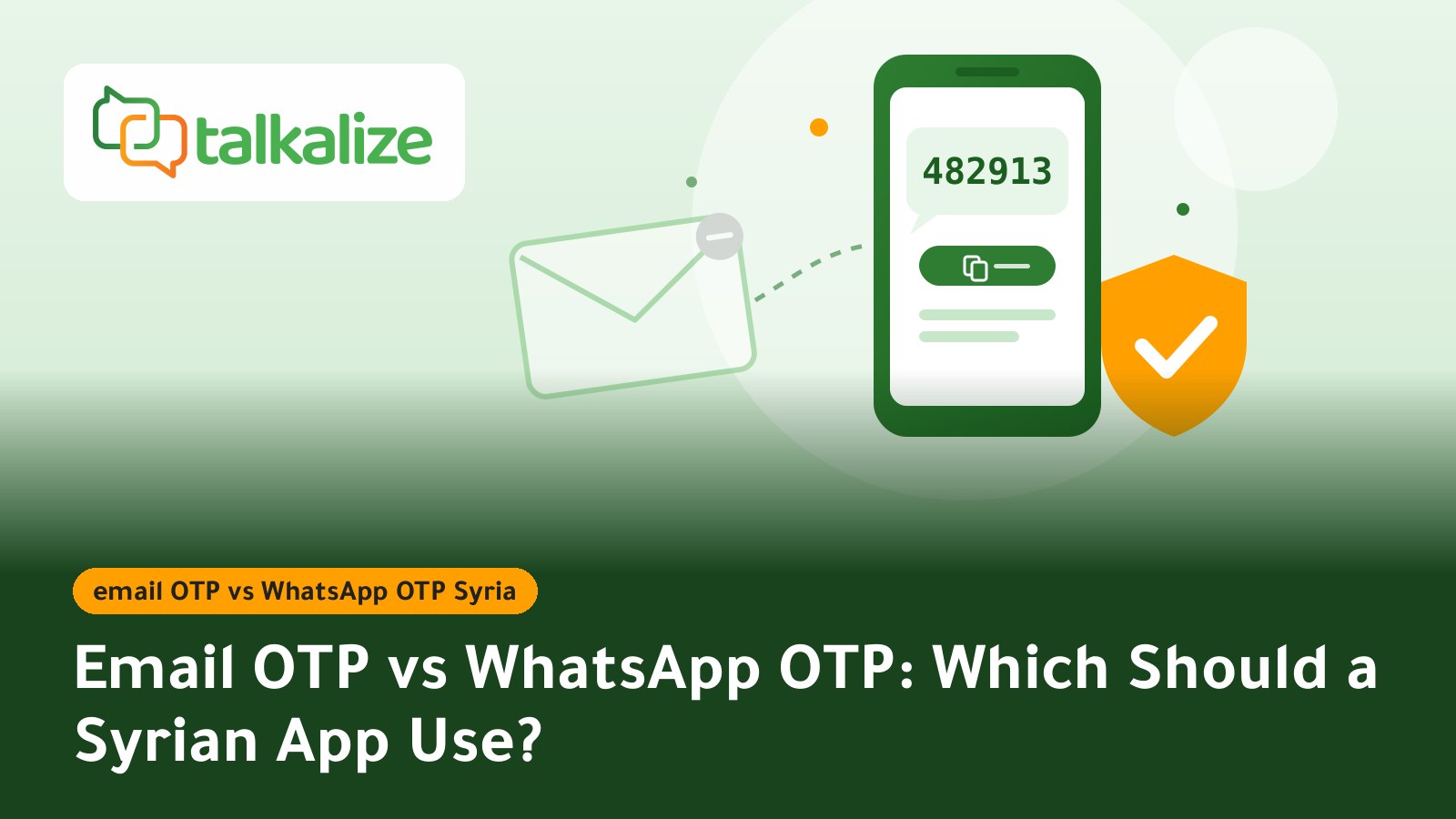
Short answer on email OTP vs WhatsApp OTP: if users sign up to your app in Syria with a phone number, a WhatsApp OTP beats an email OTP in most cases, because the phone is the device they always have in hand. With Talkalize (Talkalize - توكالايز), a WhatsApp OTP to a Syrian number costs from $0.0102, or 1,000 codes for $12 with no expiry. Email still earns a place, but as the fallback, not the main channel.
Founders and product teams in Syria keep running into the same launch-week debate: why pay for a verification message when an email costs almost nothing to send? This guide settles the email OTP vs WhatsApp OTP question for Syria on practical grounds: who actually receives the code, what each option really costs, and when running both is the smart call. The WhatsApp OTP service for apps page covers the product itself; here we focus on the decision you make before your developer writes anything.
Five facts that shape the choice
- Syria has about 9.25 million internet users, 35.8% of the population, but 20.1 million mobile connections (DataReportal, Digital 2026: Syria, published 8 November 2025).
- Median mobile download speed in Syria is 24.69 Mbps versus only 3.35 Mbps on fixed lines, according to Ookla data in the same report. Online life in Syria runs through the phone.
- Since 1 February 2024, Gmail requires every sender to set up SPF or DKIM and keep reported spam below 0.3%; anyone sending more than 5,000 messages a day also needs DMARC.
- WhatsApp Business API authentication templates let a code expire anywhere from 1 to 90 minutes and do not allow links or emojis in the message, which leaves little room for phishing.
- Talkalize is a Meta-verified Tech Provider and sends codes through the official WhatsApp Business API, with a copy-code button and one-tap autofill on Android.
Email OTP vs WhatsApp OTP: where codes get lost
An email code rarely fails at sending. It fails at arriving and being noticed. The message leaves your server fine, then lands in spam or the Promotions tab, or gets delayed because your domain is new and has no sending reputation yet. And the Syrian user who opened your app on their phone often does not check email daily; plenty of people created a Gmail account only to activate their Android phone and no longer remember its password.
A WhatsApp code lands in an app that is already open on the same device, shows your verified business name, and can be copied with one tap. The one real weakness: the user needs WhatsApp active on the number they typed. That gap is exactly why email still has a job as backup.
What users measure without telling you
Users do not care about the channel. They care about how many seconds they wait. Every time someone leaves your sign-up screen to dig through an inbox, the odds rise that they close the app for good. So the metric that matters is simple: of everyone who asked for a code, how many finished verifying?
What each option really costs (last verified: 9 November 2026)
Talkalize WhatsApp OTP prices for Syrian numbers, in USD per message, by monthly volume:
| Monthly volume | OTP price to Syria | Approximate monthly cost |
|---|---|---|
| 100 messages | $0.0109 | about $1.09 |
| 1,000 messages | $0.0106 | about $10.60 |
| 10,000 messages | $0.0104 | about $104 |
| 100,000 messages | $0.0102 | about $1,020 |
| Syria bundle | 1,000 OTP messages | $12, no expiry |
You pay as you go from a wallet, with no minimum. If you later want extras like a shared team inbox or automation, plans start with a 7-day free trial, then Starter at $49/month and Growth at $89/month. Full country rates are on the WhatsApp Business API pricing for Syria and the Gulf page.
Email looks free, but it carries hidden costs: a reliable sending service charges once you pass its free allowance, your developer spends time on SPF, DKIM and DMARC and on watching domain reputation, and, most expensive of all, some users never finish sign-up. Lose ten sign-ups out of a hundred to unread codes and the price of a WhatsApp message looks tiny next to the value of each customer.
A worked example: a job portal
Picture a jobs board in Aleppo where 3,000 job seekers register each month. Sending each one a WhatsApp code costs at most about $31.80 a month at $0.0106 per message. If 10% ask for a second code, add roughly $3.18. During a slow launch, the $12 bundle covers the first 1,000 codes and never expires.
When email on its own is enough
In fairness, email is not the wrong answer everywhere. It can carry verification by itself when:
- Your product serves companies and staff who sit at a computer all day, such as accounting or stock management software, and they genuinely use a work inbox.
- You never need the user's phone number and all communication happens by email.
- The goal is to confirm the email address itself, for example because invoices or monthly reports will be sent there.
Outside those cases, especially in apps where sign-up, ordering and support all run through the phone, WhatsApp is the better primary channel.
How to set up WhatsApp-first verification with an email fallback
- Pick the primary channel from your sign-up form: if users enter a phone number, make WhatsApp the default and keep email optional.
- Open a Talkalize account: start the free trial and connect your business WhatsApp number; our team guides you through Meta verification in Arabic or English.
- Get an authentication template approved: we help you submit it to Meta with a copy-code button, plus one-tap autofill for Android apps.
- Connect your system: your developer links your server to Talkalize through the API so a code goes out on every verification request, and delivery status comes back through a webhook.
- Add a "send the code to my email" option: show it after a short wait if the WhatsApp code has not been delivered, or when the user has no WhatsApp on that number.
- Use one set of security rules: one code valid for a few minutes, cancelled once used or after several wrong attempts, with a cap on requests per number.
- Measure for two weeks: track the completion rate per channel, then decide whether the email fallback stays or can go.
Examples from five Syrian sectors
Classifieds sites
A used-car and electronics listings site in Damascus has to know a seller's number is real before an ad goes live, because buyers will call it. A WhatsApp code proves the number works and belongs to the person posting; an email code proves nothing about the phone. A sample message:
482913 is your verification code. For your security, do not share this code. This code expires in 10 minutes.
Job portals
Job seekers upload CVs from their phones, and employers phone them back. Verifying on WhatsApp cuts fake profiles, and the portal can still ask for an email later to send matching vacancies.
Internet provider customer portals
A home internet provider in Homs runs a portal where subscribers pay and check their package. When the home line drops, the subscriber usually cannot open email on a laptop, but can still receive a WhatsApp code over mobile data and log in to report the fault or renew.
B2B wholesale ordering
A food distributor in Latakia lets grocery owners order through a web portal. A shopkeeper behind the counter is not watching an inbox, so a WhatsApp code to confirm large orders is faster, while the monthly statement goes to email.
Intercity bus booking
A coach company running routes between governorates verifies the traveller's number before confirming a seat, so schedule changes reach the same number later.
Side-by-side comparison
| Criterion | Email code | WhatsApp code via Talkalize |
|---|---|---|
| What it proves | Control of an inbox | Control of a phone number with WhatsApp on it |
| Where it lands | Inbox, spam or Promotions | A chat under your business name |
| Entering the code | Usually manual copying | Copy button; autofill on Android |
| Setup work | SPF, DKIM, DMARC and domain reputation | Meta verification and an approved template |
| Cost per code | Depends on your email provider | $0.0102 to $0.0109 |
If you are also weighing SMS, read SMS alternative for verification in Syria; for the forgot-password journey see WhatsApp OTP for password reset.
Mistakes teams make when mixing channels
- Sending the code on both channels every time: it doubles cost and confuses people; make email an on-request option.
- Two valid codes at once: when a new code goes out by email, cancel the earlier WhatsApp code.
- Using unofficial tools: ordinary WhatsApp numbers used for bulk sending get banned; the reasons are in official WhatsApp API vs unofficial tools.
- A vague fallback email: write it in clear Arabic and say it replaces the WhatsApp code, so it does not look like a scam.
How to know you chose well
After two weeks live, compare three numbers: the share of users who entered the code correctly on the first request, the average time between requesting and entering it, and how many chose email over WhatsApp. If almost nobody uses the email fallback, you can simplify the screen. If one group of users relies on it heavily, they may be registering numbers without WhatsApp, and email stays essential for them.
To budget precisely for your volume, see WhatsApp OTP price in Syria.
Get started with Talkalize
If WhatsApp is going to be your main verification channel, start with the 1,000-code bundle for $12 with no expiry. Our team helps in Arabic or English with template approval and a first test message to a Syrian number. See the bundle on the Syria WhatsApp OTP page and per-country rates on our WhatsApp OTP service page.
Frequently Asked Questions
Is email verification enough for a classifieds site in Syria?
Usually not. Buyers will call the seller's number, and an email code proves nothing about that number. A WhatsApp code shows the number works and belongs to the person posting.
Can a user get the code on WhatsApp with email as a backup?
Yes. Send the WhatsApp code first and offer email after a short wait if it is not delivered, cancelling the earlier code whenever a new one is sent.
Why can't some Gmail users find my verification email?
It may land in spam or Promotions, especially from a new domain or without SPF and DKIM, which Gmail has required from all senders since February 2024.
How long should a WhatsApp code stay valid compared with an email link?
WhatsApp authentication templates allow 1 to 90 minutes; a few minutes is best. Email links are often left valid much longer, which is weaker security.
Does a job portal still need the candidate's email after verifying their phone on WhatsApp?
Not for sign-up. It can ask for email later, as an optional field, to send matching vacancies or a copy of the application.
Do fallback emails use up the $12 Syria bundle?
No. Talkalize sends WhatsApp messages; fallback emails go through your own email provider, so the bundle is only used when a WhatsApp code is sent.